
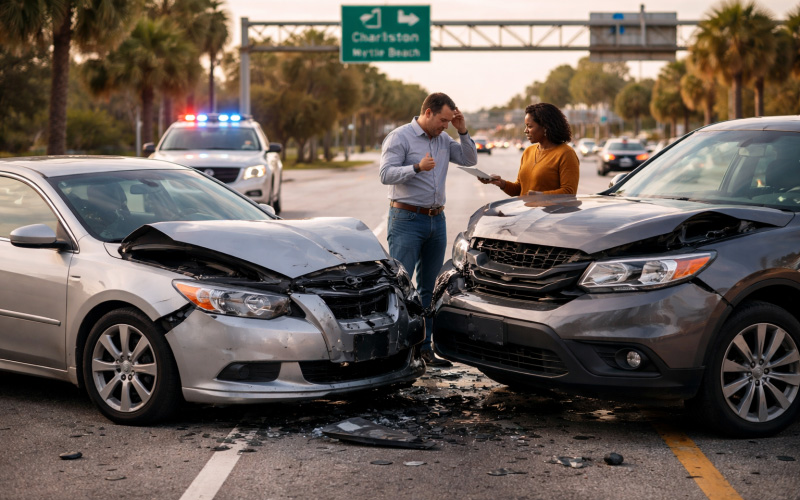
Car accidents aren’t always black and white.
In some instances, the blame or fault for an accident cannot be attributed to a single driver.
For example, a rear-end collision occurs at night, but the vehicle that was rear-ended did not have properly working brake lights.
Or, when a driver makes a left turn and fails to yield to oncoming traffic, but the vehicle they didn’t yield for was traveling at a speed well above the speed limit.
The most common instance, however, is simply when a collision occurs at an intersection and both parties claim they had a green light, with no witnesses to verify.
If you’re wondering how that affects an injury claim in South Carolina, you’re not alone.
Understanding South Carolina comparative negligence rules can make a big difference in whether you recover compensation—and how much.
Below, we break down how shared fault works, what laws apply, and what injured drivers should know when pursuing a claim.
This guide is tailored for drivers across the Lowcountry and beyond who may be considering a personal injury claim with the help of a South Carolina law firm like Seaton, Duncan, & Holmes.
South Carolina’s Modified Comparative Negligence Rule
South Carolina follows a modified comparative negligence system. This rule determines how fault is divided and how compensation is calculated when more than one party contributes to an accident.
The 51% Bar Rule
Under South Carolina law, an injured person can recover damages only if they are less than 51% at fault for the accident. If you are found to be 51% or more responsible, you are barred from recovering any compensation.
This rule is based on long-standing South Carolina case law, including Nelson v. Concrete Supply Co., 303 S.C. 243, 399 S.E.2d 783 (1991), which formally adopted modified comparative negligence in the state.
How Fault Percentages Affect Compensation
If you are partially at fault but still under the 51% threshold, your compensation is reduced by your percentage of fault.
A Simple Example
Let’s say:
- Your total damages equal $100,000
- You are found 20% at fault
- The other driver is 80% at fault
Your recovery would be reduced by 20%, meaning you could recover $80,000.
This is why determining fault is such a critical issue in partially at-fault car accident cases in SC.
How Fault Is Determined After a Car Accident
Fault isn’t decided by one factor alone. Insurance companies, attorneys, and—if necessary—a jury will review several pieces of evidence.
Common Factors Used to Assign Fault
- Investigating Officer’s Traffic Collision Report
- Traffic citations
- Eyewitness statements
- Vehicle damage and crash reconstruction
- Medical records
- Surveillance or dashcam footage
Insurance adjusters often try to assign a higher percentage of blame to reduce what they pay. That’s why many injured drivers choose to speak with a South Carolina personal injury attorney before giving a recorded statement.
What If Both Drivers Were Found At-Fault or Cited?
Being found at-fault or receiving a traffic ticket does not automatically determine fault in a civil injury case. While an at-fault determination and citations from an investigating officer may be considered, they are only one piece of the puzzle.
In practice and at trial, however, the collision report is specifically prohibited from being used as evidence of negligence or lack of due care by S.C. Code § 56-5-1290. That means hiring legal counsel that will properly investigate and gather admissible evidence to present to an insurance adjuster or jury for consideration in an at-fault or comparative negligence determination is of the utmost importance.
At Seaton, Duncan, & Holmes, we properly investigate every collision – whether that means going to the scene, interviewing and gathering witness statements, obtaining audio or video records, or consulting with an accident reconstruction specialist.
Comparative Negligence and Insurance Claims
Insurance companies apply comparative negligence principles during settlement negotiations.
If an insurer believes you share fault, it may:
- Reduce its settlement offer
- Deny liability altogether
- Push for a quick settlement before fault is fully evaluated
If negotiations stall, filing a lawsuit may be necessary to allow a jury to determine fault percentages under South Carolina law.
Why Legal Guidance Matters in Shared Fault Cases
Shared fault cases are rarely straightforward. Even small shifts in fault percentages can have a big financial impact. It is important to hire a firm focused on South Carolina personal injury law that can help gather evidence, challenge unfair blame, present a clear case for liability, and, when all else fails, proceed with filing suit and litigating your case to ensure you get the compensation you deserve.
If you’re exploring your options, you may find it helpful to review:
These resources explain how injury claims are handled and what to expect during the process.
Frequently Asked Questions About Shared Fault in SC
Can I still recover damages if I was partially at fault?
Yes. As long as you are less than 51% at fault, you can recover damages reduced by your percentage of responsibility.
Who decides fault in a South Carolina car accident?
Many insurance adjusters will attempt to negotiate and claim they can determine fault, but in reality only a jury is allowed to determine fault.
Does comparative negligence apply to wrongful death cases?
Yes. South Carolina’s modified comparative negligence rules also apply to wrongful death and survival actions.
What damages are reduced by my fault percentage?
Medical bills, lost wages, pain and suffering, and other recoverable damages are all subject to reduction based on your share of fault.
Take the Next Step After a Shared Fault Accident
If you’ve been injured in a shared fault car accident in South Carolina, don’t assume you’re out of options. Comparative negligence law often allows recovery—even when both drivers made mistakes.
The personal injury team at Seaton & Duncan helps injured individuals understand their rights and pursue fair compensation under South Carolina law.
To discuss your situation and learn how comparative negligence may apply to your case, reach out through our website to schedule a consultation today.
Taking action sooner rather than later can help preserve evidence and protect your claim.
Ready To Speak With An Attorney?
Let’s discuss the details of your case and see if we can help.